

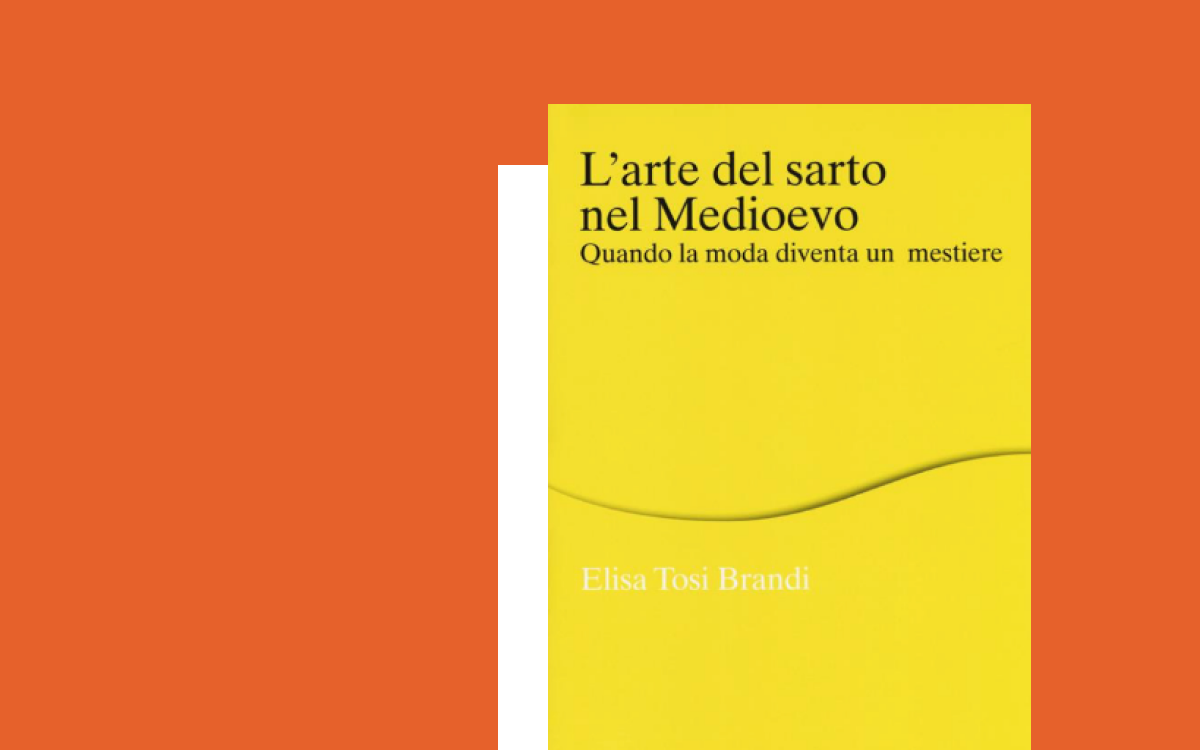
A fascinating study on Medieval Fashion and Society: The Art of Tailoring in the Middle Ages by Elisa Tosi Brandi
Abstract – L’arte del sarto nel Medioevo. Quando la moda diventa un mestiere, Il Mulino, Bologna, 2018, pp. 224 ISBN-978-88-15-25324-8)
Elisa Tosi Brandi’s L’arte del sarto nel Medioevo. Quando la moda diventa un mestiere (Il Mulino, 2017) is a seminal work that examines the evolution of tailoring in medieval Europe, exploring its impact on fashion, society, and the economy. Through an interdisciplinary approach that combines historical analysis with social and economic perspectives, Tosi Brandi sheds light on the role of tailors as key figures in shaping medieval sartorial culture. The study reveals how tailoring, initially a secondary trade, became a highly specialized profession integral to the emerging fashion system of the late Middle Ages.
Tosi Brandi, a historian specializing in medieval fashion and material culture, is a leading scholar in the field of dress history. She has contributed extensively to research on the relationship between clothing, craftsmanship, and social identity in pre-modern Europe. Her work explores themes such as the regulation of fashion through sumptuary laws, the organization of tailoring guilds, and the technical innovations that transformed medieval clothing from simple draped garments to structured and form-fitting designs.
The book delves into the hierarchical structure of tailoring workshops, the apprenticeship system, and the gendered division of labor, highlighting the crucial but often overlooked role of female seamstresses. By contextualizing medieval tailoring within the broader economic and cultural shifts of the period, L’arte del sarto nel Medioevo offers a compelling narrative that enriches our understanding of fashion as both an artistic and socio-political phenomenon.
Link: https://www.mulino.it/isbn/9788815253248
Innovation in Medieval Tailoring
The profession of tailoring in the Middle Ages was far more than a simple craft; it was a crucial element in the development of fashion, economy, and social structure. Clothing was not just a necessity but a means of communication, a marker of status, and a tool of power. Professor Tosi Brandi, a leading historian in medieval fashion studies, has extensively analyzed how the figure of the tailor evolved alongside broader economic and cultural transformations. Through her research, she unveils the complex interplay between artisans, customers, and authorities in shaping medieval dress and its social significance.
During the Middle Ages, tailoring transitioned from a rudimentary practice to a refined and highly specialized profession. Unlike earlier periods, when garments were primarily draped and pinned, medieval clothing became increasingly tailored, requiring precise cutting and sewing techniques. By the 12th and 13th centuries, tailors had secured an essential role in urban economies, crafting garments for a broad spectrum of social classes. While the nobility and wealthy merchants sought elaborate and custom-fitted clothing to reinforce their social standing, the growing urban middle class also turned to tailors to differentiate themselves through attire.
Tailoring was not an unregulated trade; rather, it operated within a structured system of guilds, which controlled access to the profession, ensured quality standards, and protected the economic interests of their members. Apprenticeship was a rigorous process, often lasting several years before an artisan could attain the status of a master tailor. These professional organizations played a crucial role in enforcing sumptuary laws, which dictated who could wear certain fabrics, colors, and decorative elements. Such laws were not merely aesthetic restrictions but reflected deep societal anxieties about class distinction, economic excess, and social mobility. Tailors, therefore, were not only craftsmen but also key mediators in the enforcement of these rules, sometimes even finding ways to circumvent them by altering garments or employing creative adaptations to accommodate clients’ demands.
One of the most significant innovations in medieval tailoring was the introduction of pattern-making and structured garments. Unlike the loose-fitting tunics of earlier centuries, clothing in the later medieval period became more form-fitting, requiring advanced techniques to shape fabric to the body. The development of tailored bodices, fitted sleeves, and precise cutting methods transformed how garments were constructed and worn. The use of fabric cut on the bias allowed for greater flexibility and improved fit, while padding and lining added structural support. These advancements laid the groundwork for the increasingly elaborate and rigid fashions of the Renaissance.
Despite their technical expertise, tailors often occupied a relatively low social status compared to other artisans. This was partly due to the perception that they merely assembled garments rather than creating new materials like weavers and dyers. However, as Professor Tosi Brandi highlights, their ability to modify, adapt, and even influence fashion trends gave them considerable economic and social leverage. Their role was particularly visible in urban centers, where the demand for luxurious and elaborate clothing was highest.
Women also played a significant role in the tailoring industry, although their contributions were often overlooked in historical records. While male tailors dominated high-status and professional tailoring, female seamstresses were integral to the production of everyday garments. They worked in workshops, participated in finishing processes such as embroidery and lining, and were often employed in informal labor networks. The distinction between male and female labor in the textile industry reflected broader gender roles in medieval society, with women’s contributions frequently remaining in the shadows despite their essential role in clothing production.
Fashion in the Middle Ages was not merely a matter of personal taste but a reflection of political power, economic change, and social hierarchy. Clothing was a visible marker of identity, distinguishing between social classes, professions, and even religious affiliations. The enforcement of sumptuary laws illustrates how deeply medieval society sought to control outward appearances, ensuring that clothing remained a clear indicator of social rank. Tailors, as the intermediaries in this system, had a unique position, balancing the desires of their clients with the restrictions imposed by authorities.
The insights provided by Elisa Tosi Brandi’s book offer a deeper understanding of how medieval tailors shaped the world of fashion, economy, and social identity. Their work was more than just craftsmanship; it was an essential aspect of urban life, influencing how people presented themselves and interacted within their communities. Through the study of tailoring, we gain a broader appreciation of the intricate web of skills, regulations, and cultural expectations that defined medieval clothing. Fashion, in any historical period, is never just about garments—it is about the people who made them, the society that wore them, and the power dynamics that dictated how they were created and displayed.