

projects
The Fabric of Power: Textile Culture in the Mycenaean World
FAROS – The Fabric of Kings: Funerary Textile Remains from Mycenae and the early Mycenaean Textile Production
Both The Ariadne’s Threads Project (ATP) P.I Alessandro Greco and FAROS – The Fabric of Kings P.I. Stella Spantidakis explore the significance of textile production in the Mycenaean civilization, focusing on its economic, social, and cultural impact. These projects investigate how textiles, from high-status garments to everyday fabrics, played a pivotal role in shaping Mycenaean society.
ATP examines the palatial textile economy through the study of Linear A and Linear B tablets, highlighting administrative records related to wool production and textile manufacturing. The project employs advanced imaging and material analysis to reveal traces of textiles, animal hides, and even fingerprints on clay tablets, offering new insights into the organization of Mycenaean industry.
FAROS shifts the focus to an earlier period, analyzing textile remains from the elite Shaft Graves of Mycenae. Using interdisciplinary approaches—including microscopic analysis and experimental archaeology—it reconstructs the techniques and materials used in early Mycenaean textile production, tracing their evolution into the palatial era.
Both projects emphasize the role of textiles as a form of wealth, prestige, and cultural identity, reinforcing the idea that Mycenaean textiles were not just fabrics but symbols of power, connecting local craftsmanship with broader Mediterranean exchange networks.

Project Overview
Our understanding of Late Bronze Age textile production in mainland Greece has traditionally relied on evidence from the palatial period, including textile tools, iconography, written documents, and textile remains. However, knowledge of textile production during the early Mycenaean period has remained limited.
The FAROS project (The Fabric of Kings: Funerary Textiles from Mycenae and the Early Mycenaean Textile Production, 2023-2025), hosted at the University of the Peloponnese and funded by the Hellenic Foundation for Research and Innovation (HFRI project no. 7534), offers a unique opportunity to study textile production during the Shaft Grave period through an interdisciplinary approach. By examining textile remains from the Grave Circles of Mycenae alongside evidence from textile tools, iconography, and palatial period sources (Linear B documents, iconography, textiles), the project sheds new light on the technological level of this era.
Objectives of the FAROS Project
FAROS aims to shed light on the textile culture of the early Mycenaean period, focusing on elite funerary textiles from the 17th-16th centuries BCE, discovered in the Grave Circles A and B at Mycenae. The project combines modern scientific tools and ancient sources to understand the mechanisms of early Mycenaean textile production, focusing on tools and techniques. At the same time, since the project’s primary material consists of textiles from the Funeral Circles of Mycenae, intended for prominent individuals, another aim is to identify the technical characteristics of the luxurious fabrics designed for the elite of the period. Finally, through an interdisciplinary approach and the comparative study of textile remains and other sources, the project seeks to explore the evolution of Mycenaean textile production from the early period currently under investigation to the palatial period, for which more information is already available.
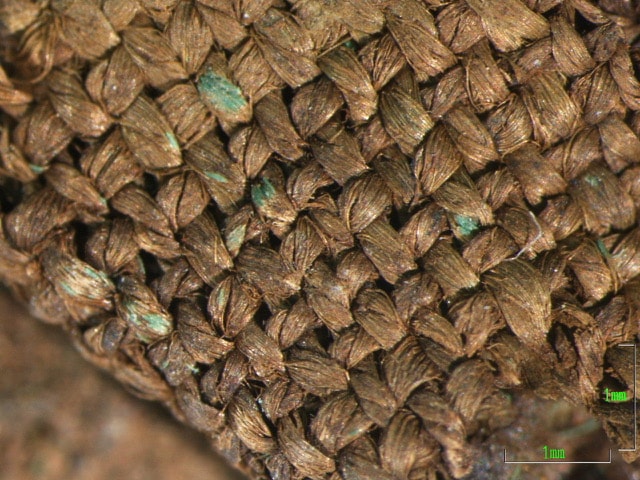
02. Picture of a Micenean fabric (detail of the weave of fabric inv. No. 8589, Grave N, Grave Circle B, Mycenae Photo Chr. Moulherat)
The project’s primary objectives include:
- Analyzing the technical aspects of early Mycenaean textiles, including materials, fiber processing, production techniques, and decorative methods.
- Exploring the characteristics of textiles associated with the Mycenaean elite, to understand the role of textiles in expressing identity and social status.
- Comparing the textile technology of the early Mycenaean period with that of the later palatial period, to trace the evolution of textile production over time.

03. Dr Christina Margariti (left) Dr Stella Spantidakis (right)
Methodology and Scientific Approach
FAROS adopts a multidisciplinary methodology that combines:
- Literature and historical research, to establish a comprehensive understanding of Mycenaean textiles.
- Macroscopic and microscopic analyses, to examine textile remains in detail.
- Scientific techniques, such as High-Performance Liquid Chromatography (HPLC will be performed by A3TEX Center) and radiocarbon dating, to identify materials and dyes.
- Experimental archaeology, which plays a crucial role in reconstructing textile tools and weaving samples using replica looms, to test production and decorative techniques.
Initial research results indicate the presence of diverse materials, including plant and animal fibers, along with various textile qualities and decorative techniques. Some textiles feature royal symbols, such as the use of purple dye and tapestry decorations, demonstrating the high level of craftsmanship in early Mycenaean textile production. These findings suggest that the textiles buried with the Mycenaean elite were of exceptionally high quality, reinforcing the Homeric depiction of Mycenae as “rich in gold“.
Participants
Principal Investigator: Dr Stella Spantidaki
Research team:
- Dr Christina Margariti (Direcorate of Conservation of Ancient and Modern Monuments, Hellenic Ministry of Culture)
- Dr Christophe Moulherat (Sorbonne Abu Dhabi)
- Dr Georgianna Moraitou (National Archaeological Museum)
- Dr Kalliopi Sarri
- Dr Nikolaos Charokopos
- Lia Andreakou


